
If you want Willamina’s mature firs, oaks, and maples to stay safe and healthy for decades, pruning is the best tool you have. Good tree service here begins with an arborist actually looking at the tree. The goal is to keep it standing, and removal only comes up when nothing else will work.
Willamina is tucked right where the Coast Range foothills run into the farmland of Polk and Yamhill County. That means big trees shade almost every home and pasture in the area. Marble Tree Service is led by arborists, fully licensed and insured (Oregon CCB #[VERIFY NUMBER]), and we look at the whole canopy when we care for a tree, not just the branch in front of us.
Quick Cuts
- Pruning to ANSI A300 standards helps trees hold up against Willamina’s wind and ice storms, and it does so without hurting their long-term health.
- Fungal conks, cracks, and thinning crowns are signals to get a tree health assessment first. The chainsaw can wait.
- Removal is the last resort, saved for trees that are a genuine safety hazard. Often the wood can go back into the property as mulch.
- On rural land, forestry mulching is a cleaner way to cut wildfire fuel than burning brush piles.
Why Tree Care in Willamina Is Different
Trees have it tough here. Winter rain soaks the soil along Willamina Creek and the South Yamhill River, and once the ground is saturated, roots lose their hold. Unfortunately, that’s right when the winter windstorms tend to show up.
Then there’s ice. A glaze of it can put a surprising amount of weight on a limb, and after a hard freeze we routinely find bigleaf maples and Oregon white oaks that have dropped big branches.
Each local species has its own quirks:
- Douglas fir: Tall and shallow-rooted in wet soil, often planted too close to homes decades ago.
- Oregon white oak: Slow-growing and ecologically valuable, sensitive to soil compaction and over-pruning.
- Bigleaf maple: Prone to heavy, codominant limbs that split under load.
- Western redcedar: Shows drought stress as browning tops after hot, dry summers.
A lot of properties around here are rural acreage, so summer brings its own worry: wildfire fuel. Thick brush, dead material, and ladder fuels (low branches that give a ground fire a path up into the canopy) pile up faster than most people expect.
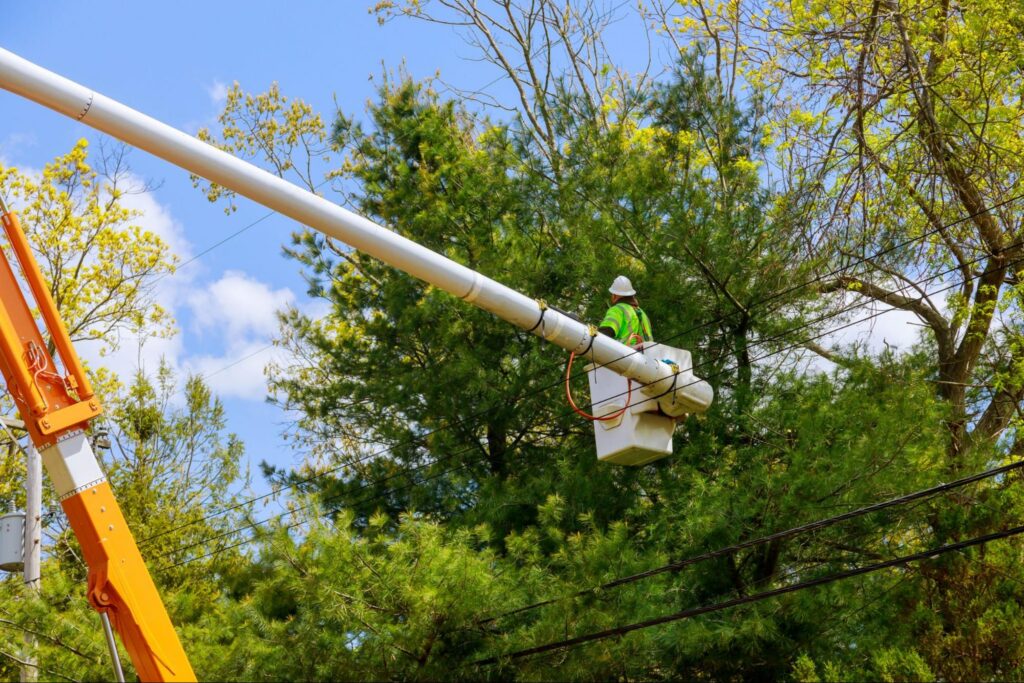
All of this feeds into what we recommend, and it starts with knowing what to watch for.
Signs Your Trees Need an Arborist
A tree doesn’t have to be dying to need help. Catching the early signs of trouble gives you time to fix a small issue before it turns into a dangerous one. Give an arborist a call if you see:
- Dead, broken, or hanging limbs (often called “widowmakers”)
- A trunk that has started leaning or shifted after a storm
- Fungal conks, the shelf-like mushrooms, at the base or on the trunk
- Deep cracks or splits in the trunk or major limbs
- A thinning crown with sparse foliage or early leaf drop
- Branches touching your roof, siding, or power lines
We go deeper on a few of these in our post on warning signs for tree trimming. And if a tree has already died, getting dead tree removal done promptly keeps it from coming down on its own schedule.
When you search “arborist near me,” pay attention to who takes the time to explain what they’re seeing instead of just handing you a number. Once you’ve spotted a problem, the next question is which service fits.
Tree Services for Willamina Homes and Land
The right tree service depends on the condition of the tree. Here’s a quick look at how our main services stack up:
Service | What It Is | When It’s Needed | Stewardship Benefit |
Tree health assessment | On-site evaluation of structure, roots, and disease | Any warning sign, or every few years | Catches problems early so trees can be saved |
Tree pruning | Selective cuts to improve structure and health | Young trees, storm prep, clearance | Extends tree life and reduces failure risk |
Tree trimming | Shaping and clearance work | Limbs near roofs, roads, or lines | Keeps trees and homes coexisting |
Tree removal | Taking down a hazardous or dead tree | Unsafe trees that can’t be saved | Protects people and nearby trees |
Stump grinding | Grinding the stump below grade | After removal | Reclaims space, reduces pests |
Forestry mulching | Grinding brush and small trees in place | Acreage, fire fuel reduction | Returns nutrients to soil, avoids burning |
Health Evaluations and Pruning
The International Society of Arboriculture notes that hiring a certified arborist ensures tree care meets professional standards.<sup>1</sup> Our pruning follows ANSI A300, the national standard that spells out proper cuts and how much can safely be removed.
For young trees, structural pruning steers growth toward one strong trunk. Crown cleaning takes out dead, diseased, and crossing branches. Crown thinning, where we selectively remove some interior limbs, lets wind move through the tree rather than catching the canopy like a sail.
One thing we won’t do is top a tree. Topping means cutting the main stems back to stubs, and it leads to weak regrowth and decay. A topped tree almost always ends up more dangerous than it was before.
Removal, Stump Grinding, and Emergency Care
Every so often, a hazard tree assessment tells us a tree simply can’t be made safe. When that happens, careful removal protects your house and the trees nearby. We handle storm damage the same way: make the scene safe first, then figure out what can stay.
Once the tree is down, grinding the stump keeps the spot usable. Putting off stump grinding can invite pests, spread fungus, and leave a tripping hazard behind.
Fuel Reduction and Forestry Mulching for Acreage
Out on the rural land around Willamina, overgrown brush and fire risk go hand in hand. Defensible space is the buffer around your buildings where fuel has been thinned out, and it gives your home a much better shot when wildfire season hits.
A forestry mulching company turns that brush into mulch right where it stands. No burn piles, no smoke. And like everything else we do, it follows the same basic process.
Our Stewardship Approach: Assess, Preserve, Then Remove
Here’s how every job works for us:
- On-site assessment: A certified arborist inspects the tree’s roots, trunk, and crown.
- A care plan: We explain findings in plain language and outline options.
- Preservation-first work: Tree pruning, cabling, or soil care before any removal.
- Responsible reuse: Wood becomes mulch, firewood, or habitat rather than landfill waste.
- Replanting recommendations: We suggest native species suited to your site.
When a mature tree comes down, you lose shade, wildlife habitat, and a natural sponge for stormwater. Careful work is how a local tree company preserves the environment, one yard and one pasture at a time.
Plan Long-Term Care for Your Willamina Trees
The healthiest trees in town are the ones that get steady attention, not the ones that only see a crew after a storm. Spending a few hours on pruning and an assessment now can head off damage later and keep your canopy healthy for the next generation.
Schedule a Tree Health Evaluation with a Marble Tree Service Arborist to Plan Care for Your Willamina Property
If you’ve been looking for a “tree service near me” that cares about keeping trees healthy, we’d love to walk your property with you. Schedule a tree health evaluation with a Marble Tree Service arborist, and we’ll put together a care plan that keeps your family safe and your trees standing strong. Call us at (503) 867-1634 today.
Frequently Asked Questions
How much does tree service cost in Willamina, OR?
Tree removal and tree trimming costs come down to a handful of things: the tree’s size and species, where it sits, how easy it is to reach, and how close it is to buildings.
What is the best time of year to trim or prune trees in Willamina?
While dead or hazardous branches should be removed immediately regardless of season, late winter to early spring (during dormant season) is generally ideal for major pruning in Western Oregon. Pruning before spring growth starts minimizes stress on the tree, helps wounds heal faster, and reduces susceptibility to local pests and fungal diseases encouraged by wet Pacific Northwest weather.
Do I need a permit to remove a tree on my private property in Willamina?
Permit requirements depend on the tree’s location, size, and whether it sits within a hazard zone or critical area like a riparian buffer along local waterways. Standard tree removal on private residential property often does not require a municipal permit, but trees located in public rights-of-way or environmentally protected zones usually do. It is best to check with the City of Willamina Planning Department or have a certified arborist assess the location prior to removal.
How do damp Pacific Northwest winters affect tree health and safety?
Heavy rainfall, high winds, and winter storms typical of Yamhill and Polk counties can saturate soil, weakening root anchorage and increasing the risk of uprooting—especially for top-heavy or diseased trees. Additionally, constant moisture encourages wood rot, moss, and fungal infection. Regular hazard assessments and crown thinning help reduce wind resistance and keep trees structural sound year-round.
How much does professional tree removal or trimming cost in Willamina, OR?
Costs vary based on the tree’s height, species, proximity to structures or power lines, and overall condition. On average:
- Tree Trimming/Pruning: $250 to $850
- Tree Removal: $400 to $1,800+ for large or high-risk trees
- Stump Grinding: $150 to $450
Most reputable local tree care companies offer free on-site estimates after evaluating access and scope of work.
Sources
- International Society of Arboriculture (TreesAreGood.org). Why Hire an Arborist.
“Jason was professional, courteous, and did a great job not only trimming but also cleaning up. The price was right, and he’s local. My wife and I are lifelong residents of the Forest Grove area and we pride ourselves in doing local business. Marble Tree Service is a great example of why we do so. Thanks for everything, Jason. If you’re concerned about which choice to make, look no further. This business came HIGHLY recommended by my neighbors and will be mentioned as such to all our family, friends, and associates.”
– J.S.